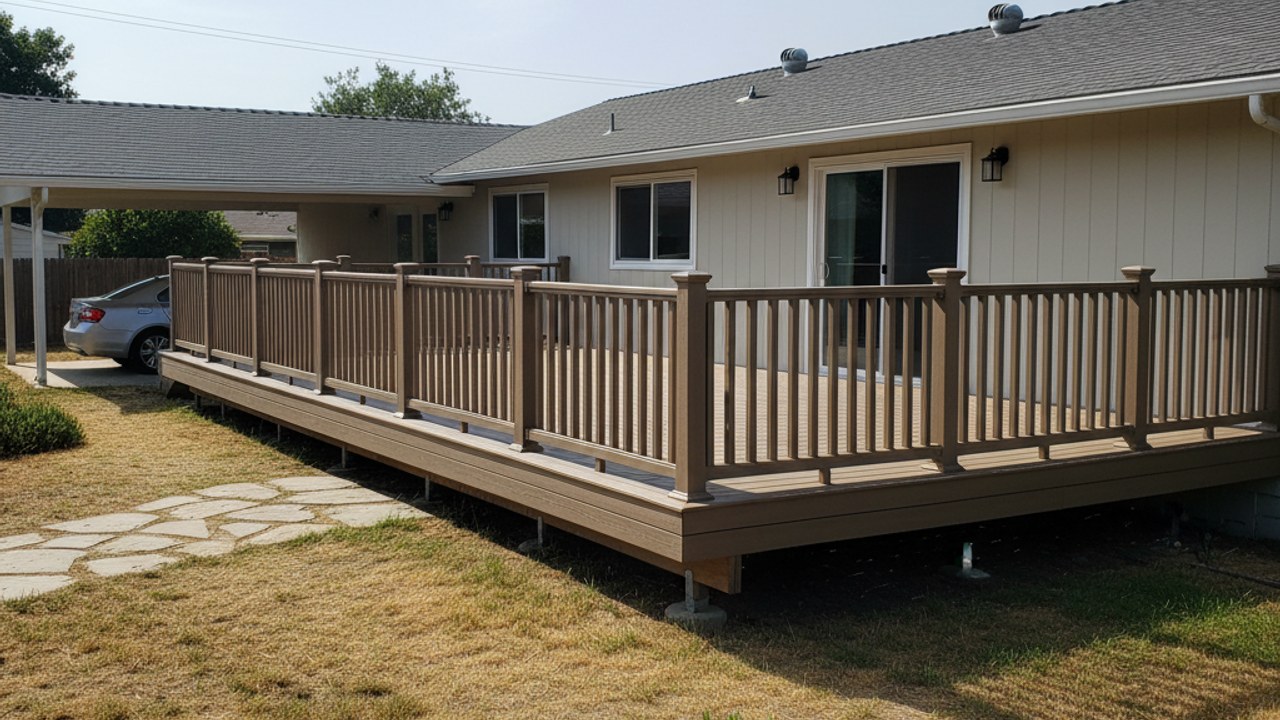
Anyone with a truck and a saw can call themselves a deck builder. Not everyone can pull a permit, size a footing for a hillside lot, or tell you why your ledger board is the single most important connection on the whole structure. Here's what actually separates a contractor worth hiring from one you'll be calling back in three years.
Check the license, and check what it covers
In California, deck work should be done under a licensed contractor, either a B (general building) or C-13 (fencing, but many C-13s also do decks and rails). Ask for the license number and look it up on the CSLB website yourself. It takes two minutes and it tells you if the license is active, if there's a bond in place, and if there are complaints on file. Ask for proof of workers' comp insurance too. If a framer falls off a second-story deck on your property and the contractor has no coverage, that liability lands on you, not them.
A lot of small operators in LA work as handymen and take on deck jobs because the demand is there. That's fine for resurfacing a landing or swapping out a few rotten boards. It's not fine for anything that involves new framing, a ledger attachment to the house, or a structure more than 30 inches off grade, because at that point the city wants a permit and an inspection, and an unlicensed handyman generally isn't pulling one.
Permits aren't optional here, and skipping them costs you later
Los Angeles Department of Building and Safety requires a permit for most new deck construction and for structural repair work. Contractors who tell you "we don't need a permit for this" are usually telling you that so they can work faster and cheaper, not because the code doesn't apply. The inspection points that matter are the footing inspection, done before any concrete gets poured, and the framing inspection, done before the decking boards go down and hide the joists. Skip those and you have no record that the footings are sized correctly or that the joist hangers are actually nailed off with the right fasteners, not just tacked in place.
This matters more when you go to sell the house. Unpermitted structural work shows up on a title report or gets flagged by a buyer's inspector, and it becomes your problem to fix or disclose. If your lot is in a hillside zone, think Mount Washington, Silver Lake, the Hollywood Hills, or parts of Eagle Rock, the permit process usually involves a soils report and engineered footings, sometimes caissons drilled down several feet to reach competent bearing soil. That's not a place to cut corners with a contractor who wants to skip the paperwork.
Ask how they're handling the ledger, the footings, and the soil
A good deck builder will talk your ear off about connections most homeowners never think about. The ledger board, the piece bolted to your house that the whole deck hangs off, needs proper flashing behind it so water doesn't wick into your rim joist and rot it from the inside. This is the single most common failure point on older LA decks, especially on 1920s through 1950s bungalows in neighborhoods like Highland Park or Leimert Park where the original framing was never built to hold a deck load in the first place.
Footings depend on soil, and Los Angeles soil varies block to block. Flat lots in the Valley often sit on decomposed granite or sandy fill that drains fine but doesn't compact the way clay does. Older lots closer to the basin can have adobe clay that expands when wet and shrinks in the dry season, which shifts footings over time if they're not poured deep enough or below the active zone. A contractor who gives you a generic "12 inches and we're good" answer without asking about your soil or your slope isn't sizing the job to your lot, they're using the same footing on every job regardless of what's underneath it.
Because this is earthquake country, the connections between posts, beams, and the house also need lateral bracing, not just vertical support. Post-Northridge code updates tightened up how decks attach to houses for exactly this reason. Ask a candidate builder how they're bracing against lateral movement. If they look confused, that's your answer.
Materials and the LA sun problem
Wood decking in Los Angeles takes a beating from UV, not from freeze-thaw like it would somewhere with real winters. Redwood and cedar hold up well but need to be resealed roughly every two to three years, more often on a west-facing deck that gets full afternoon sun. Pressure-treated Douglas fir is cheaper and structurally sound for framing but isn't what you want as a walking surface without a good stain schedule.
Composite decking has gotten a lot better and a lot of homeowners here go that route specifically to skip the resealing cycle, but composite still expands and contracts with heat, so it needs the right gap spacing and fastening system or you'll get buckling in August when a deck can sit at 140 degrees in direct sun. Closer to the coast, in places like Venice or Santa Monica, salt air in the marine layer speeds up corrosion on fasteners and hardware, so stainless or coated hardware isn't a nice-to-have out there, it's the difference between ten years and twenty.
What to walk away from
- A quote with no line item for permits, or one that says permits are "extra if you want them."
- A contractor who can't tell you the joist spacing they're planning to use, or gives you a spacing that ignores your span and decking material.
- Anyone who wants full payment up front. A deposit is normal, the balance should follow the work.
- No mention of flashing at the ledger. This is the detail that separates a deck that lasts from one that rots from the house out.
- A design with no plan for drainage underneath, especially if the deck sits low to grade. Standing water under a deck in a heavy January storm is how you get mold and post rot within a few seasons.
Get two or three bids, and don't just compare the bottom number. Compare footing depth, fastener type, and whether the permit is baked into the price. A deck is one of the few home improvements that's outside, structural, and holding people above grade all at once, so the margin for shortcuts is small. We handle the design, the permitting, and the framing ourselves at Classic Deck Co, and we're happy to walk through what a job like yours actually needs before you sign anything.